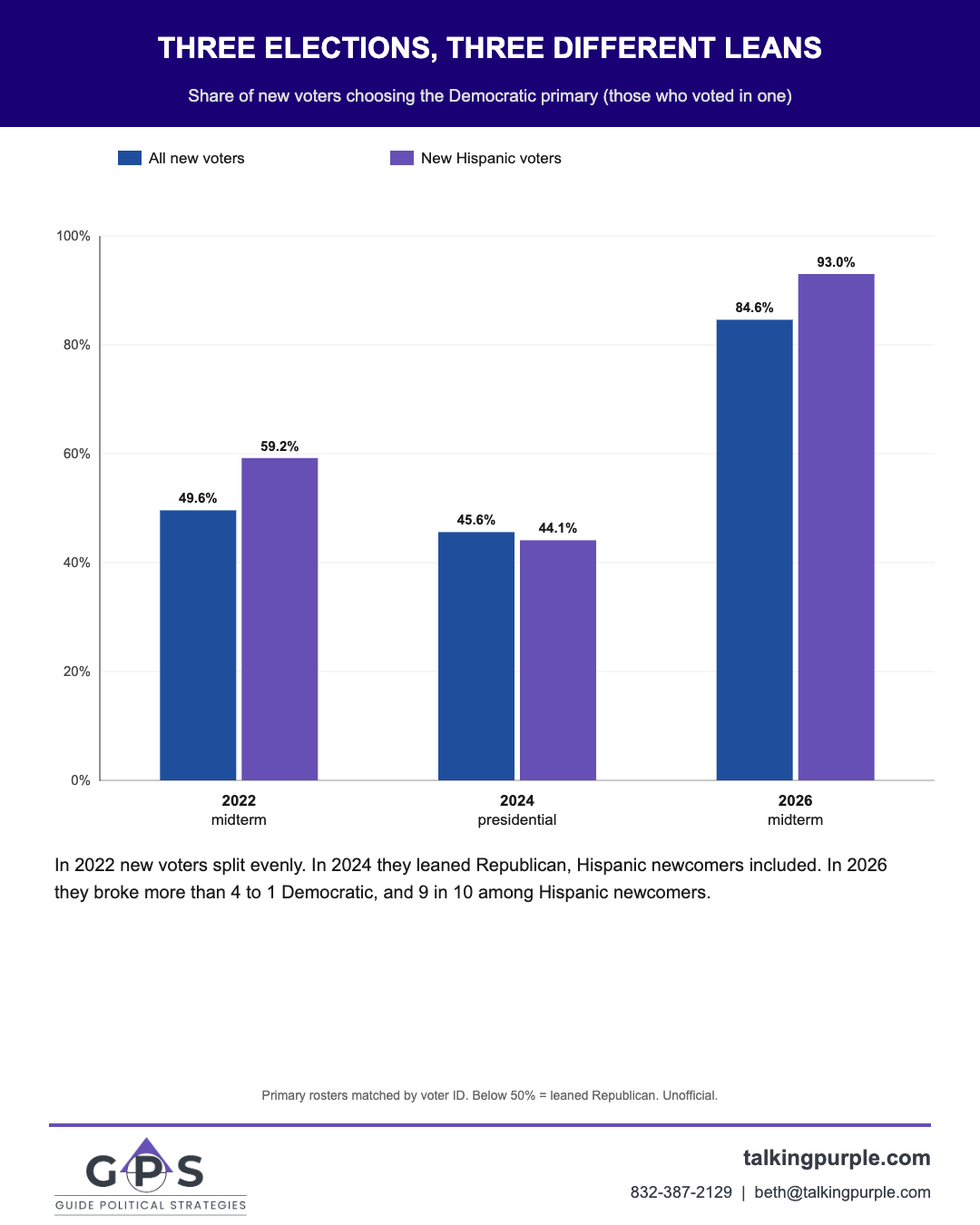
Over the past two days I have laid out what the voter rolls show about the 2026 election in Harris County and across Texas. In Something Doesn’t Add Up in Texas, I explained why I believe the state needs to verify the eligibility of every new voter before this election is certified. In Two Years, Two Different Electorates, I showed how Harris County’s new voters went from leaning Republican in 2024 to breaking better than four to one Democratic in 2026.
Today I want to ask the question nobody seems to be asking: who registered these people, and was anyone checking?
We Have Been Watching the Wrong Door
For the last several cycles, Republicans have poured energy into voter roll cleanup, voting machines and mail ballots. Those are worth watching. But the one part of the process that has gotten almost no attention is the front door: how people get on the rolls in the first place.
Texas does not require documentary proof of citizenship to register. You check a box saying you are a U.S. citizen and sign under penalty of perjury. The state then tries to catch problems after the fact by matching registrations against Department of Public Safety records and the federal SAVE database. That system has gaps, and the state’s own citizenship review in 2025 showed its tools are imperfect. If thousands of registrations came in during the months before the election, I do not believe anyone can say with confidence that every one of them was fully checked before those people voted.
Some will point out that a Texas voter ID number comes from the county registrar, not from the federal government. That is true. But it sharpens the point rather than answering it. If people who are not citizens are on the rolls, they got there through our own registration process, by checking a box, and the question is whether anyone caught it.
Is 188,000 New Voters Even Possible?
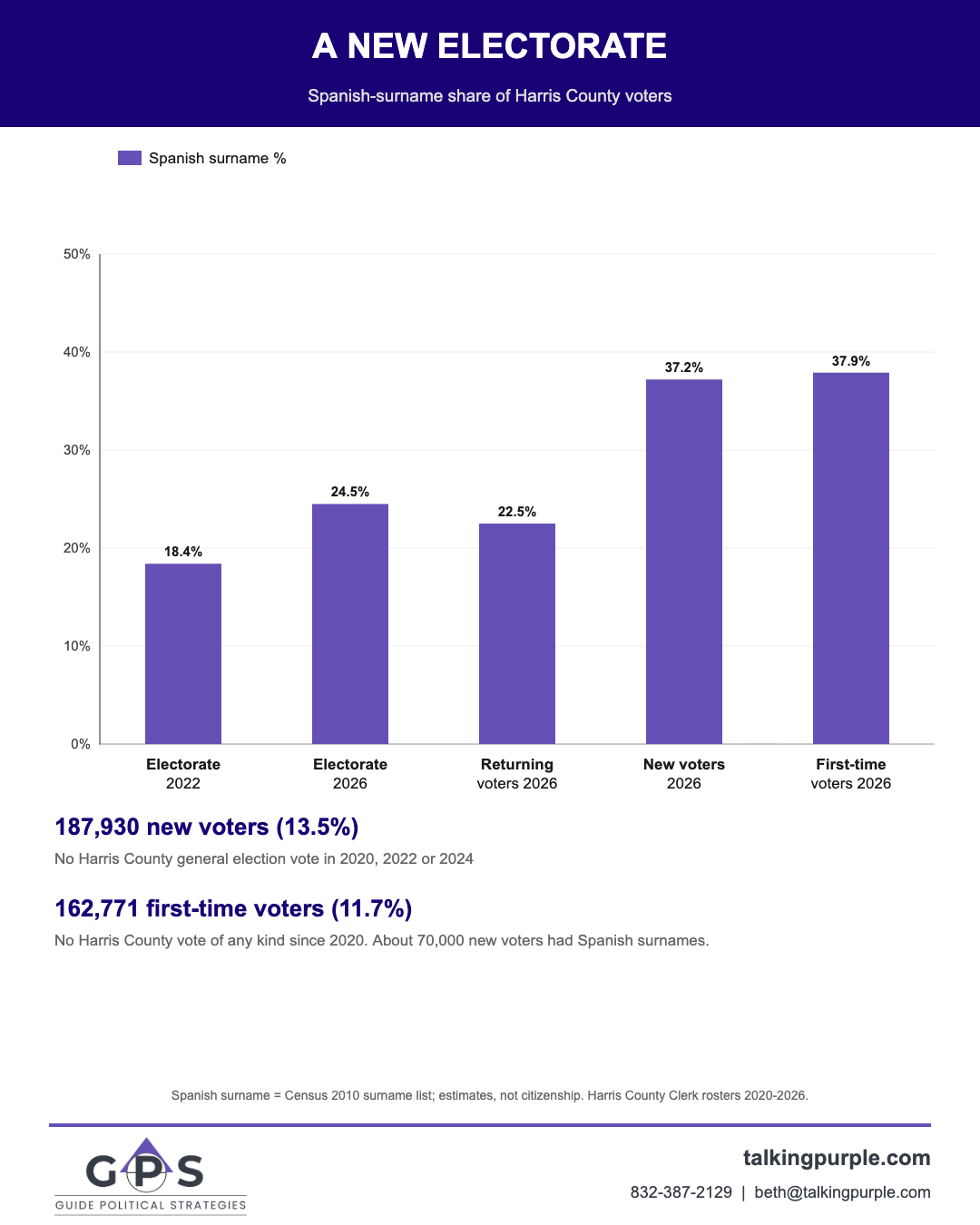
Harris County had 187,930 voters this year with no general election vote here since 2020. Not all of them are brand-new registrations. Some registered years ago and simply never voted. But it is fair to ask whether it is even feasible to bring that many new people into the system in a short time.
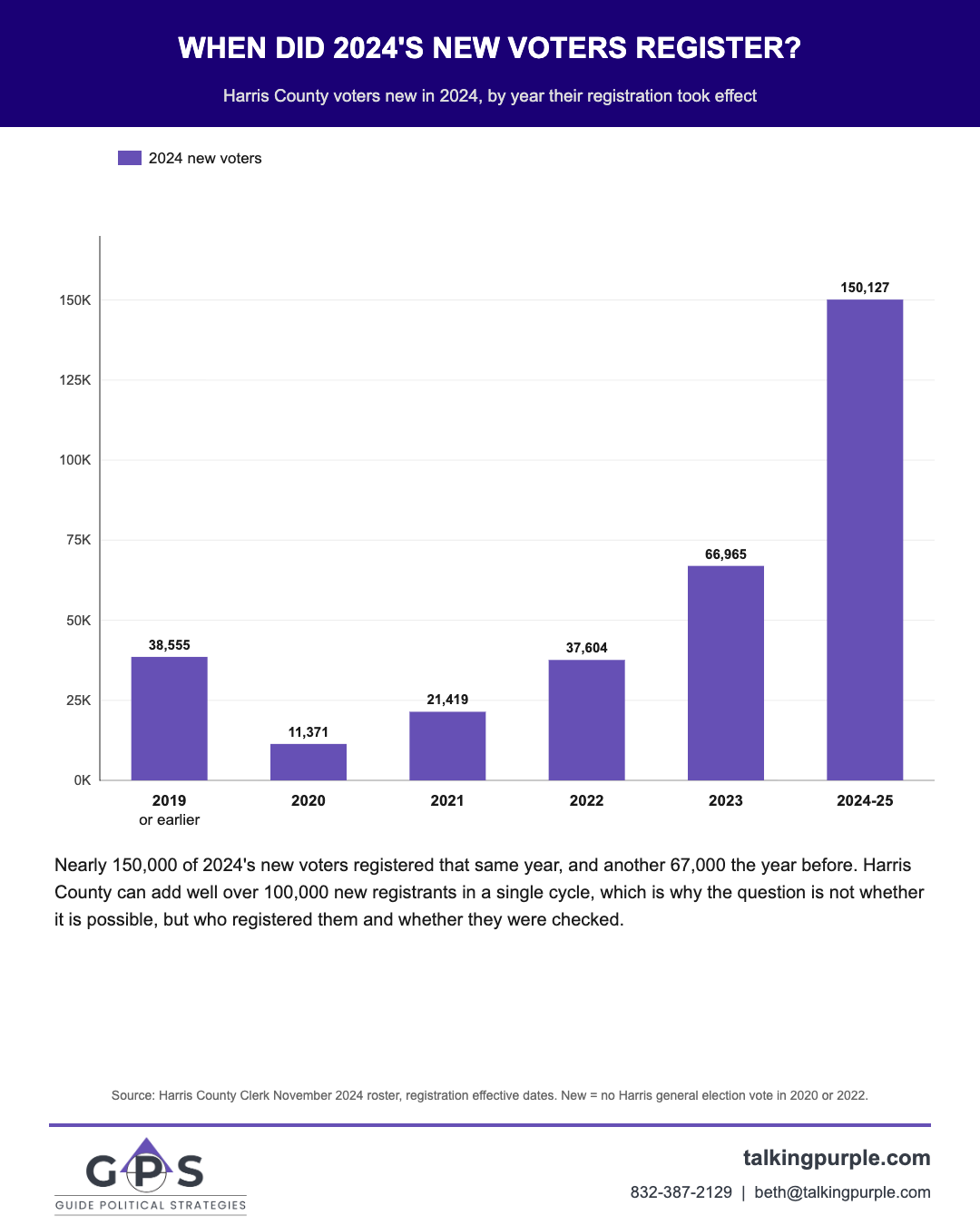
The county’s own records answer that. Of Harris County’s new voters in 2024, nearly 150,000 had registered that same year, and another 67,000 the year before. In other words, Harris County can add well over 100,000 new registrants in a single election cycle. Large numbers are possible. That is exactly why the question that matters is not whether it can be done, but who did it, how, and whether every applicant was eligible.
Two Cycles, Not One
Looking at 2026 alone misses the bigger picture. I believe this is an aggregate of two election cycles, and that having Donald Trump on the ballot in 2024 masked what was happening.
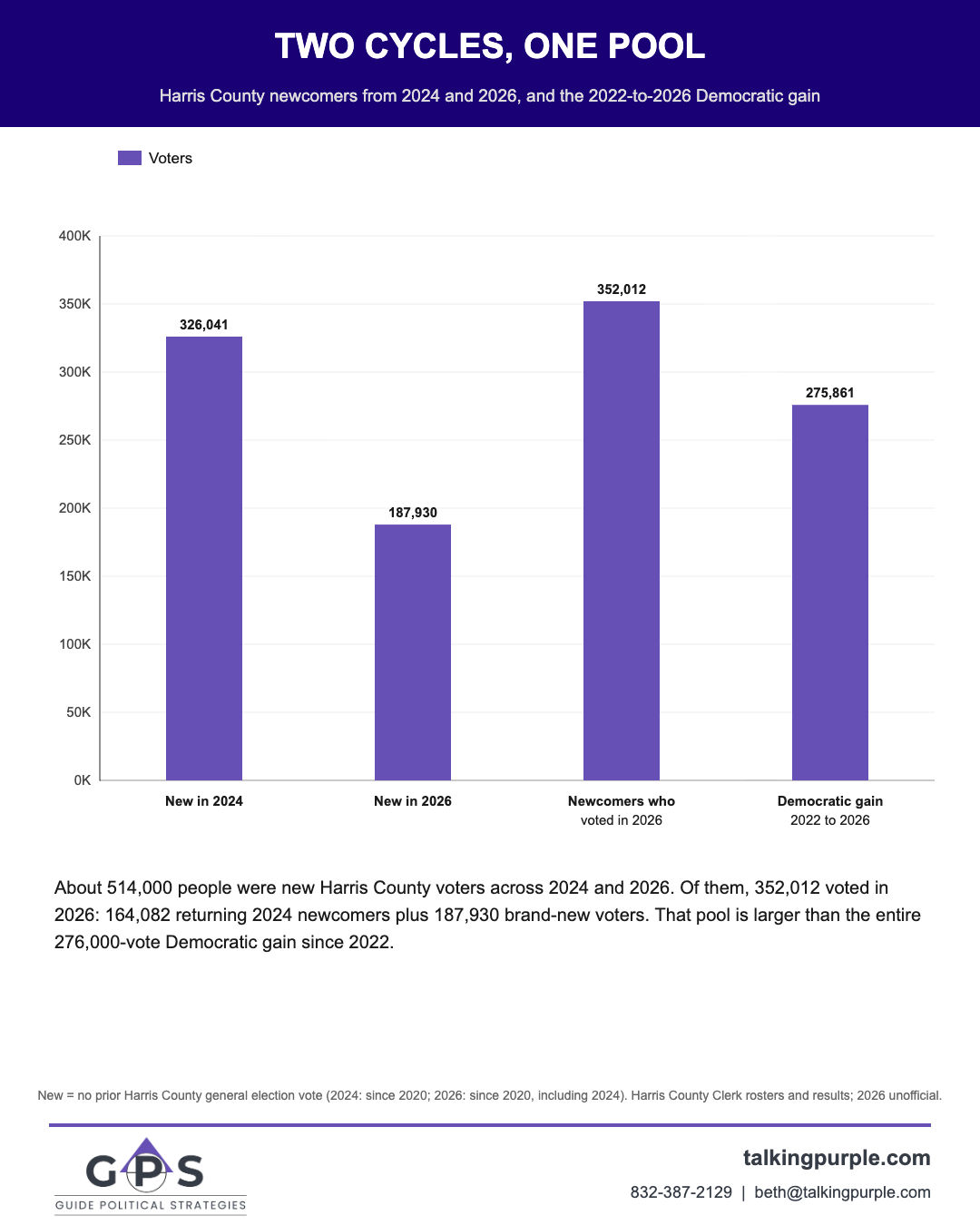
In 2024, Harris County had 326,041 new voters, people with no general election vote here in 2020 or 2022. In 2026, it had another 187,930. That is about 514,000 newcomers across two cycles. In 2024, with Trump driving turnout on both sides, their effect was hidden inside a presidential electorate, and the newcomers who voted in the primary even leaned Republican. In 2026, with no Trump on the ballot and Republican turnout back at midterm levels, the newcomers stood out.
Of those two waves, 352,012 voted this November: 164,082 who first voted in 2024 and came back, plus the 187,930 brand-new voters. Meanwhile, the average Republican candidate in Harris County got about 505,000 votes, essentially the same as 2022, and the average Democrat gained about 276,000. The newcomer pool from the last two cycles is larger than the entire Democratic gain.
Will verifying these voters overturn this election? Probably not by itself. Even if a share of them turn out to be ineligible, the margins in most races are large. But that is not the point. If ineligible registrations have been building up across two cycles, they will keep building, and each election they will tilt the field a little more. Checking the newcomers from both 2024 and 2026 is how we make sure everyone competes on a level playing field going forward, in 2028 and beyond.
That is why my request to the Secretary of State covers both cycles: run the citizenship check on every voter who registered in 2023 through 2026 and voted in either 2024 or 2026, not just this year’s new voters. In Harris County alone, that includes 217,092 people who registered in 2023 or 2024 and voted for the first time in 2024 (about 55,400 with Spanish surnames), 113,303 of whom voted again in 2026, plus the 187,930 brand-new voters this year. Together that is roughly 405,000 voters in Harris County whose eligibility has never been tested by a full election cycle of checks.
Where the Pattern Would Show Up
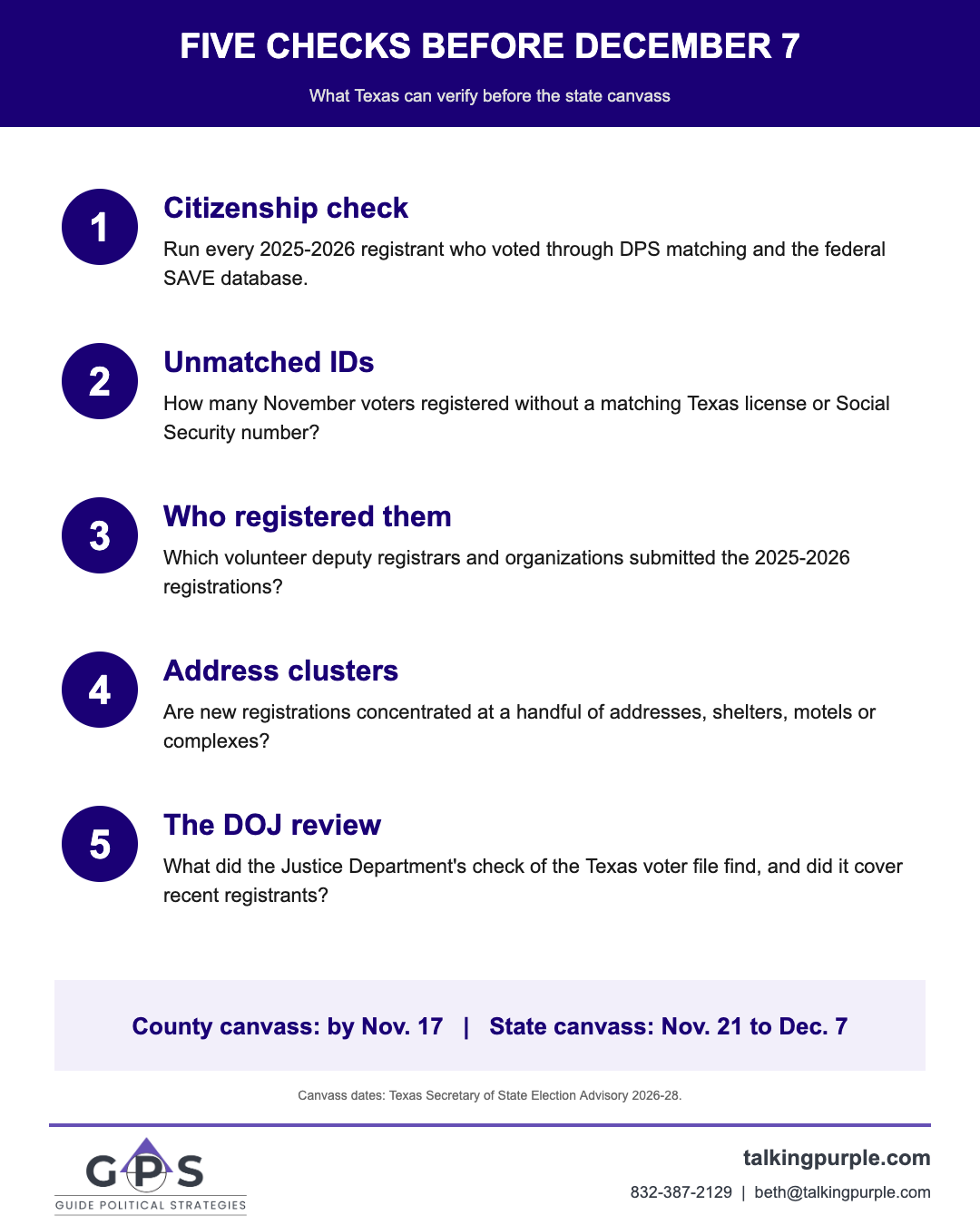
If large numbers of ineligible people were registered, it would not be invisible. Registration leaves a paper trail, and there are five places to look:
1. The citizenship check. Run every 2025 and 2026 registrant who voted in November through DPS matching and SAVE. If a meaningful number come back as noncitizens, we will know. If almost none do, we will know that too.
2. Unmatched IDs. How many November voters registered without a matching Texas driver’s license or Social Security number? That is the group most likely to have slipped past the state’s matching.
3. Who registered them. In Texas, voter registration drives are run through volunteer deputy registrars appointed by the county, and every application they collect goes back to the registrar. Counties know which deputy registrars and organizations submitted the 2025 and 2026 registrations. If a small number of drives account for a large share, or a share with unusual problems, that is a lead worth following.
4. Address clusters. Are new registrations concentrated at a handful of addresses, shelters, motels or apartment complexes? Clusters like that are easy to find in the data and easy to check in person.
5. The Justice Department’s review. The state provided its voter file to the Justice Department to check for noncitizens. What did that review find, and did it cover people who registered in the last two years?
The Clock Is Running
Here is the problem. Texas counties must complete their local canvass, which finalizes county and precinct races, no later than November 17. The state canvass, which finalizes statewide, federal and district races, must happen between November 21 and December 7. A standard public information request can take weeks, and longer if the agency asks the attorney general for a ruling. By the time the answers arrive, the results will be certified.
That means the requests have to go straight to the people who can act now. The Secretary of State already has DPS and SAVE access and ran a statewide citizenship review in 2025, so the process exists. Governor Abbott conducts the state canvass. Senator Cruz and Attorney General Paxton can press for answers. And our state senators and representatives can ask the Secretary of State for this data and get it far faster than any member of the public.
What I Am Asking For
I am asking the Secretary of State, Governor Abbott, Senator Cruz and Attorney General Paxton to do five things before the state canvass: run the citizenship check on every voter who registered from 2023 through 2026 and voted in 2024 or 2026, report how many registered without matching ID numbers, identify which deputy registrars and organizations submitted those registrations, flag unusual address clusters, and release the results of the Justice Department’s review. In Harris County, that is roughly 405,000 voters: 217,092 who registered in 2023 or 2024 and first voted in 2024, and 187,930 new voters in 2026. I will gladly provide their voter ID numbers so the check can be run directly.
Let me be clear about what I am and am not saying. I am not alleging fraud, and I am not saying anyone who voted did anything wrong. I am saying we have a voter eligibility problem: a large new electorate came in through the one door nobody was guarding, and the state has the tools to check it. Even people who disagree with me about what happened should want this answered. If every new voter checks out, we can all accept the result with confidence. If they do not, we will know exactly where to fix the system before 2028.
If you agree, call or email your state senator and state representative today and ask them to request these five checks from the Secretary of State before the state canvass.
Data: Harris County Clerk voter rosters, 2020 to 2026, including November 2024 registration effective dates; Texas Secretary of State Election Advisory 2026-28 (canvass dates). New voters are defined by Harris County voting history, not registration date. 2026 results are unofficial.
Talking Purple | 832-387-2129 | beth@talkingpurple.com
Related posts:
- Political Campaign Verification and 10DLC Registration: The Complete 2026 Compliance Guide
- Common Sense Over Chaos: Immigration, the Dignity Act, and Why We Need Real Solutions
- The Trump Manifesto, Newsom’s Bad Trump Cosplay & The Gerrymandering Lie
- Game 7: Sunday Stays Democratic on the Lightest Day of Harris County Early Voting