Early voting for the November 3 midterm opened Monday, October 19, and the first day brought heavy lines in much of the state. Raw turnout numbers make for good headlines, but they don’t tell you much on their own. Texas adds hundreds of thousands of voters every cycle, so a “record” day one in 2026 isn’t the same as a record in 2018.
We pulled the official day-one numbers for Texas’ 10 largest counties from the Texas Secretary of State for 2018, 2022 and 2024. Then we compared them with what each county reported for 2026. Here’s what stands out.
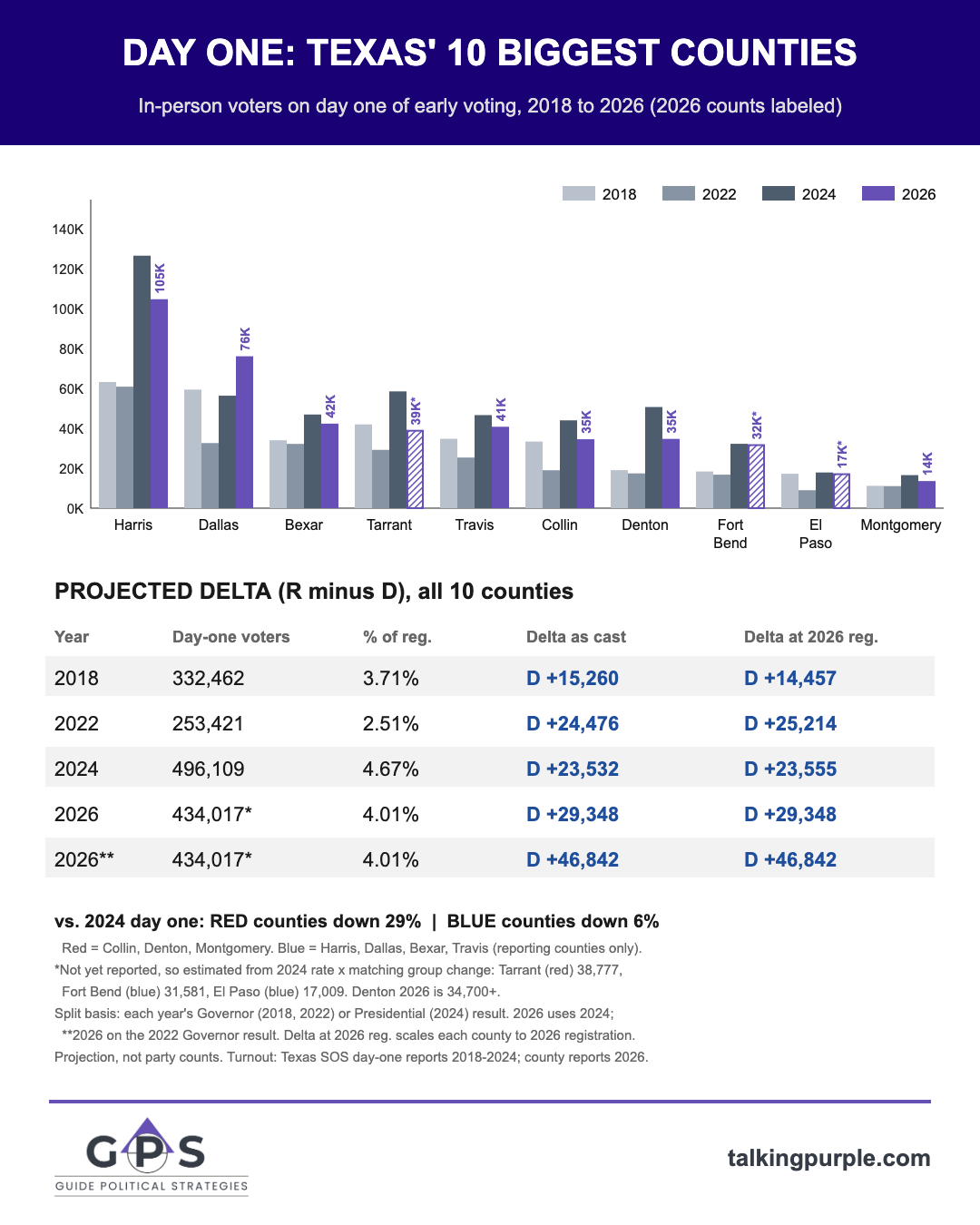
The 10 counties
By current registration, the 10 biggest counties in Texas are Harris, Dallas, Bexar, Tarrant, Travis, Collin, Denton, Fort Bend, El Paso and Montgomery. Together they hold more than half of the state’s registered voters.
Four of them are red: Tarrant, Collin, Denton and Montgomery. Republicans won all four in 2018, 2022 and 2024. Five are reliably blue: Harris, Dallas, Bexar, Travis and El Paso. Fort Bend is the swing county in the group. Greg Abbott carried it by about two-tenths of a point in 2018, and it has gone narrowly Democratic since.
Turnout: strongest midterm start of the three
To factor out population growth, we measured day-one in-person voters as a share of registered voters.
| Year | Day-one voters | % of registered |
|---|---|---|
| 2018 | 332,462 | 3.71% |
| 2022 | 253,421 | 2.51% |
| 2024 | 496,109 | 4.67% |
| 2026 | 434,017 | 4.01% |
At 4.01%, 2026 is running well ahead of both recent midterms. It’s even above 2018, which was itself a high-turnout year. It’s still about 13% below the 2024 presidential pace, which is normal for a midterm.
Dallas County is the only one of the 10 that beat its own 2024 day one, with 76,079 voters compared with 56,341 two years ago.
Red counties vs. blue counties
This is where the day-one picture gets interesting. Compared with their 2024 day one:
- Red counties (Collin, Denton and Montgomery) are down 29%.
- Blue counties (Harris, Dallas, Bexar and Travis) are down 6%.
Both groups are well above their 2022 numbers. But in 2024, red counties turned out at a noticeably higher rate on day one than blue counties did. In 2026, the two groups are nearly even. Denton fell the furthest, from 50,661 day-one voters in 2024 to about 34,700 this year. Montgomery dropped from 16,546 to 13,579.
What that means for the projected party split
Texas doesn’t register voters by party, so we can’t count Republicans and Democrats directly from day-one turnout. What we can do is estimate. We split each county’s day-one voters by how that county actually voted in a recent election, then add up the results.
| Year | Projected margin, 10 counties |
|---|---|
| 2018 | D +15,260 |
| 2022 | D +24,476 |
| 2024 | D +23,532 |
| 2026 | D +29,348 |
These are the state’s big metro counties, so the projected margin leans Democratic every year. The 2026 margin is the widest of the four. If you use the 2022 governor’s race as the yardstick instead of the 2024 presidential race, the 2026 margin grows to D +46,842, mostly because Harris County was more Democratic in 2022.
What day one doesn't tell you
A few cautions before anyone draws big conclusions:
- It’s one day out of 12. Republican voters in Texas have shifted toward voting later in early voting and on Election Day. A slow day one in red counties can be made up quickly.
- Three counties hadn’t reported. Tarrant, Fort Bend and El Paso had not posted day-one counts when we ran these numbers. We estimated them using each county’s 2024 day-one rate, adjusted by how much similar counties changed. Tarrant, the biggest red county on the list, will be the first real test once its number posts.
- The 2026 numbers are unofficial. They come from county reports and will be updated as the Secretary of State’s site catches up.
- A projection isn’t a party count. It assumes day-one voters in each county split the way the whole county voted. Early voters don’t always do that.
The bottom line
Day one in Texas’ biggest counties shows strong midterm energy overall. The enthusiasm gap that favored red counties on day one in 2024 has narrowed sharply. Whether that holds through the rest of early voting is the question for the next two weeks. We’ll keep tracking it as the counties report.
Frequently asked questions
When does early voting end in Texas for the November 2026 election?
Early voting runs from Monday, October 19 through Friday, October 30. Election Day is Tuesday, November 3.
Where does day-one early voting data come from?
Official daily turnout comes from the Texas Secretary of State, which posts each county’s in-person and mail ballot counts. Counties also post their own daily reports and voter rosters, usually by the next morning.
Can you tell who people voted for from early voting data?
No. Texas doesn’t register voters by party, and ballots are secret. Analysts estimate partisan makeup from where turnout is happening or from voters’ primary election history.
Why compare turnout as a percentage of registered voters?
Because Texas keeps growing. Comparing the share of registered voters who turned out keeps the comparison fair across years.
Which of Texas' 10 biggest counties are Republican?
Tarrant, Collin, Denton and Montgomery voted Republican in the 2018 and 2022 governor’s races and the 2024 presidential race.
Related posts:
- Ep 12: Breaking the Echo Chamber in Houston: Harris County Politics, Flooding, Crime, and Voting by Results
- Common Sense Over Chaos: Immigration, the Dignity Act, and Why We Need Real Solutions
- The Trump Manifesto, Newsom’s Bad Trump Cosplay & The Gerrymandering Lie
- Happy 250th, America: Birthright Citizenship and the Long Game