The 2026 midterm will be talked about for years. The question is what will be said. Will it be remembered like Chicago in 1960, or as the year young voters changed the country’s direction? I believe it is neither. I believe illegal immigrants voted in this election in numbers large enough to change results in Harris County and across Texas, and I believe the system that let it happen is still wide open.
I am not making that claim lightly. I have spent the past week going through the numbers down to individual precincts, and what I found does not fit any normal explanation. That is why I am asking our state leaders to do one thing before this election is certified: verify the eligibility of every new voter.
It Didn't Feel Right
I have looked at turnout models and at polls, many of them sampled heavily toward Democrats, that still showed races within one or two points. My own early voting models assumed independents would break about 65 percent one way, not 95 percent. None of it prepared me for the results, and it has not felt right since Gina Hinojosa was declared the winner.
To be fair, some of it makes sense. James Talarico was everywhere, every day. And truth be told, Ken Paxton was a terrible candidate, and not only because of his personal baggage. Try finding a sign or a shirt supporting him at the convention. An endorsement from President Trump does not guarantee a win. People noticed.
Driving home from a funeral in Jacksonville, I heard the explanations on TV: diesel at $6 a gallon, grocery prices and, in Texas, school vouchers. I would add property taxes and homeowner’s insurance. I am on board with the affordability argument. I do not know how families with ordinary jobs are managing. It all sounded plausible. Then I got back to my computer.
The Statewide Numbers
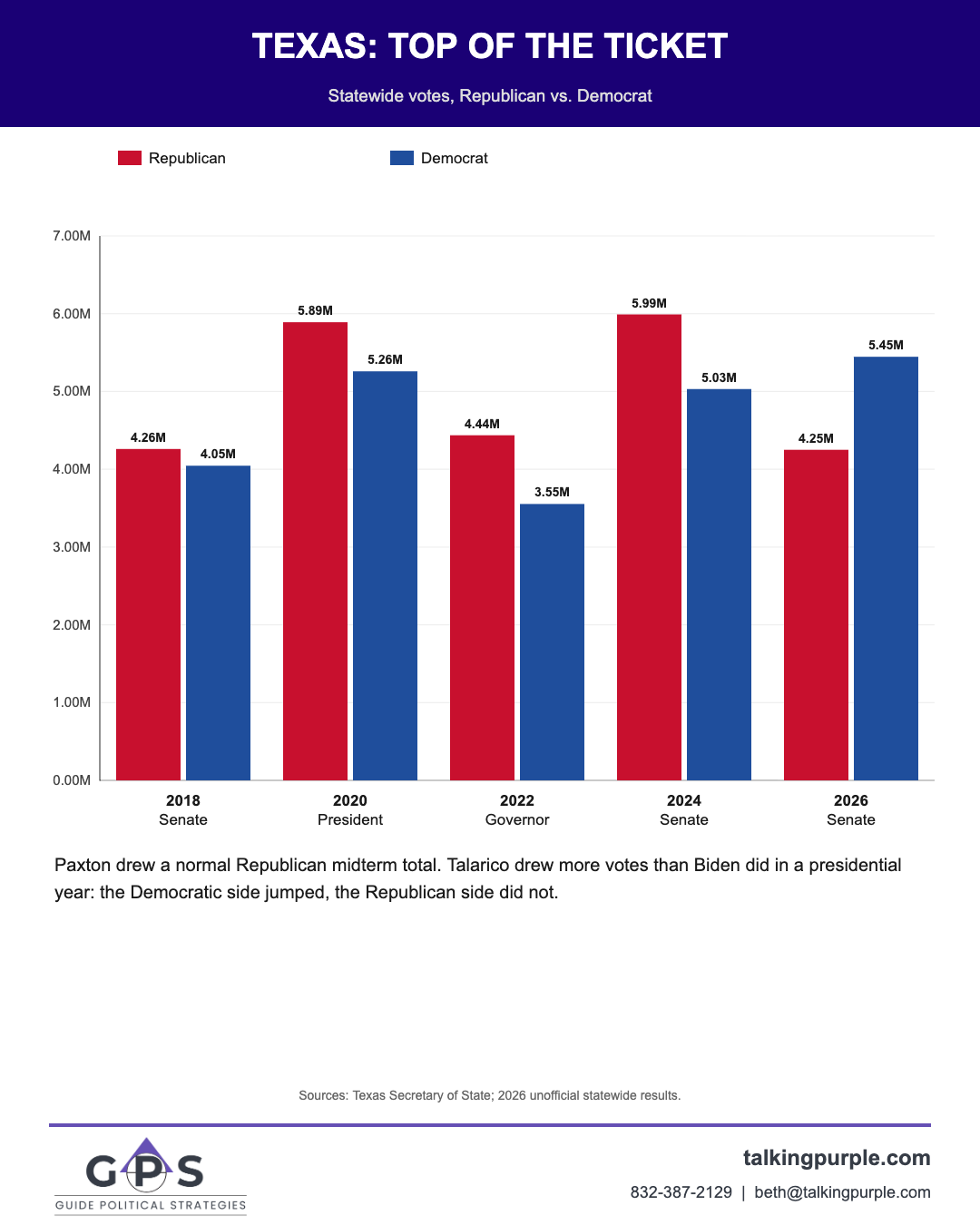
Beto O’Rourke was a formidable candidate in 2022, and he still drew only 3.55 million votes, 43.9 percent. In 2026, Democrats nominated Gina Hinojosa, a state representative well known in Austin but, by her own description, not widely known statewide. Here in Harris County she has nowhere near the name recognition you would expect behind a swing of this size.
Talarico’s win is easier to believe. Paxton was that weak. But look at the totals. Statewide, Talarico got about 5.45 million votes, more than Joe Biden got in 2020 (5.26 million) in a presidential year with record turnout, about 611,000 more than Kamala Harris and about 415,000 more than Colin Allred. Paxton got about 4.25 million, a normal Republican midterm total. Republicans showed up at midterm levels. Democrats showed up at presidential levels, and then some, in a midterm. That almost never happens.
Governor Abbott Is Not Blameless
Governor Abbott owns part of this. For as long as he has been governor, he could have pushed the Legislature to require proof of citizenship to register for Texas state and local elections. Texas cannot set those rules for federal races, which are governed by federal law, but it controls its own elections, and it never closed that door. Twelve years in office was plenty of time.
And after 12 years as governor, he ran as a change candidate. That message undercut itself: if things need changing, voters ask who has been in charge. He should have run against the Democrats as the obstruction standing in the way of fixes like this one, rather than as the agent of change in a state he has led for over a decade.
Harris County
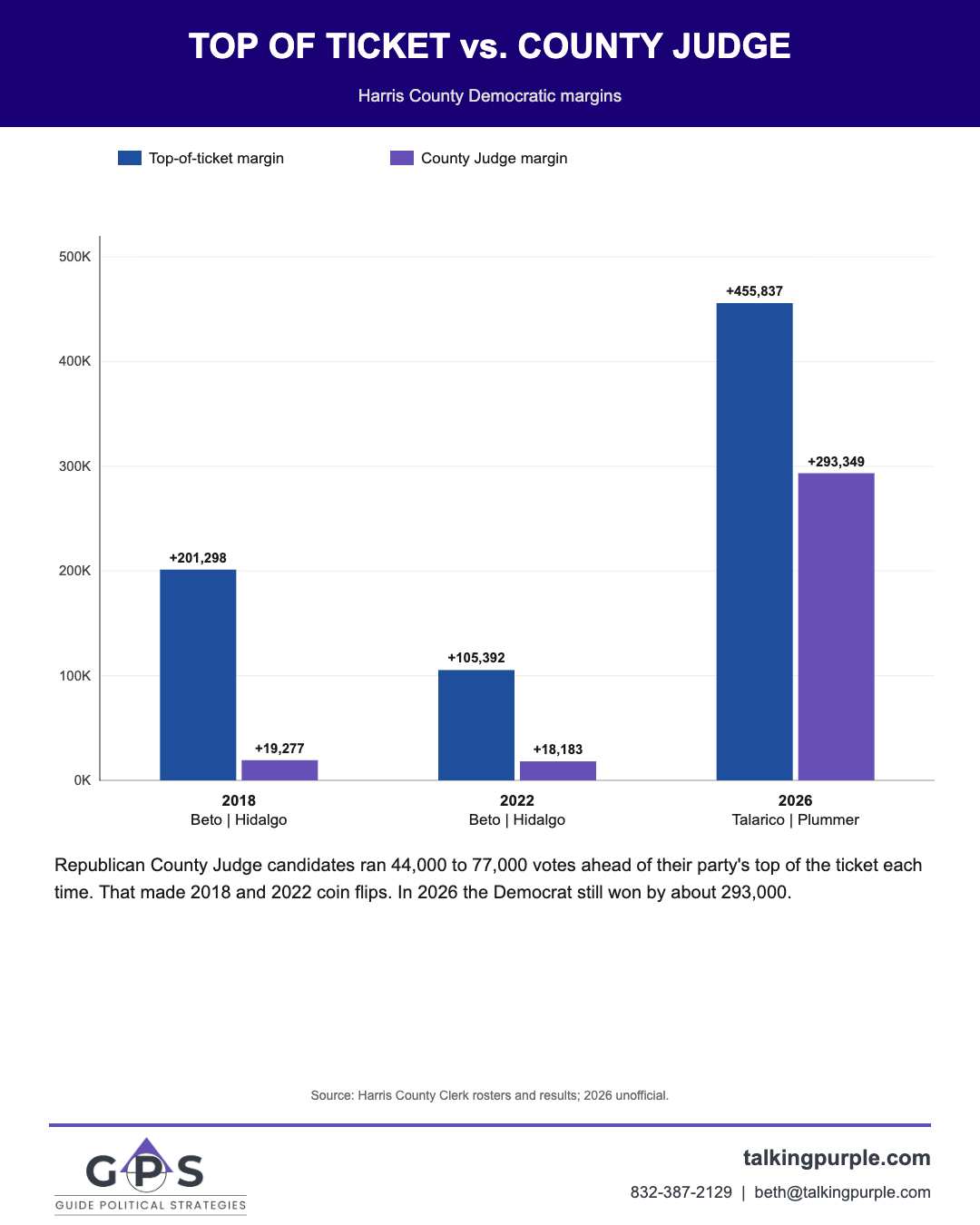
In Harris County, Talarico got 907,617 votes, almost exactly Biden’s 2020 total here, and his Harris County margin of about 456,000 votes was roughly 38 percent of his statewide lead.
Then I looked down the ballot, starting with Orlando Sanchez for County Judge, and that is where my real questions began. I expected ticket-splitting, as voters did for Ed Emmett, and Sanchez did run about 71,000 votes ahead of Paxton. But he still finished with 39 percent and lost by about 293,000 votes to a candidate who supported the county’s tax increase, in what everyone called a kitchen-table election. Crime was a close second among voter concerns, and Letitia Plummer ran on what I consider a soft-on-crime platform. Lina Hidalgo won by about 19,000 votes in 2018 and about 18,000 in 2022. In 2026, the Democrat won by about 293,000.
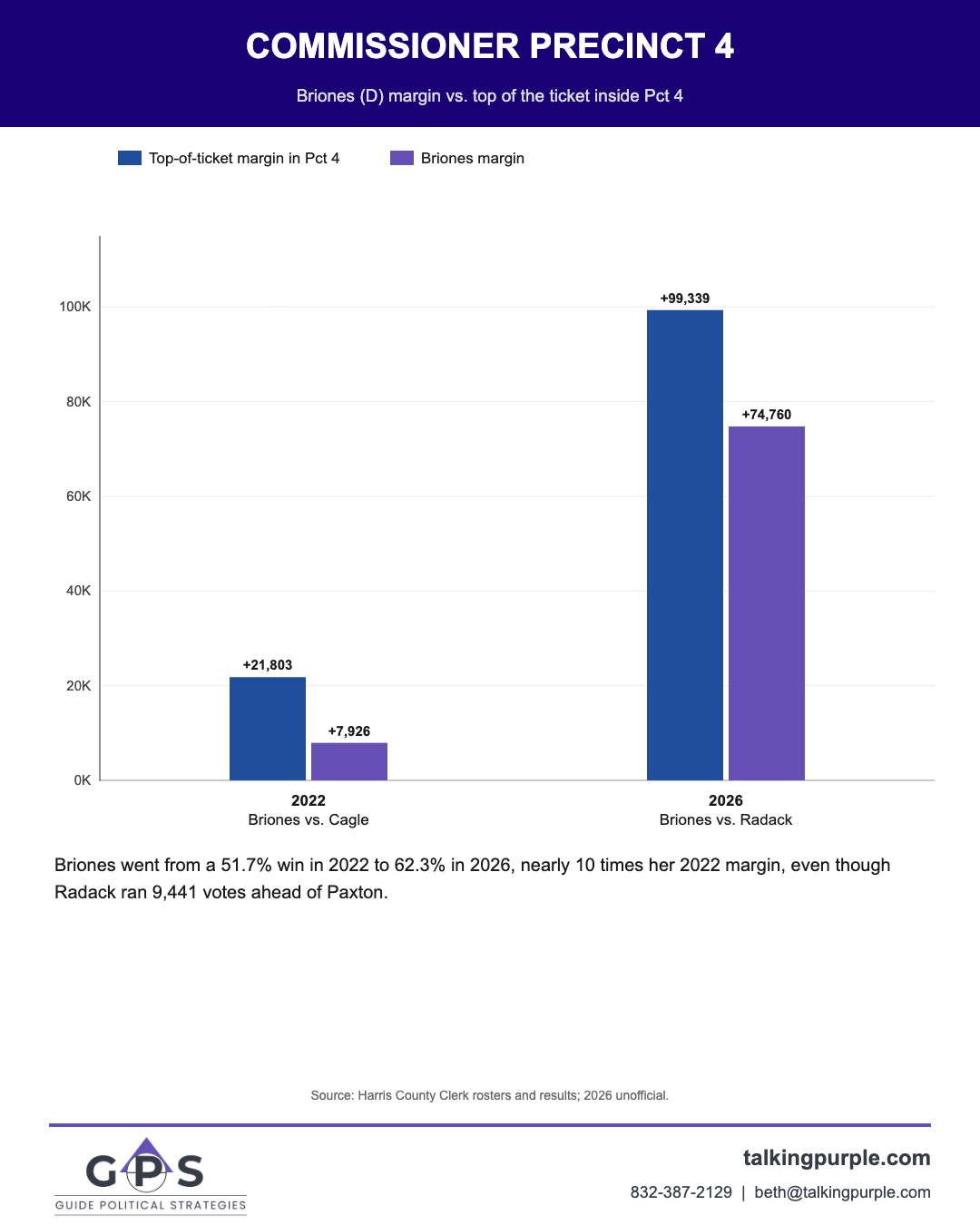
That made me turn to Commissioner Precinct 4. Steve Radack is well known and once represented much of that area. He ran against Lesley Briones, who had just voted for the county’s largest tax increase and who, it has been alleged, hired major donors into high-paying positions. I was told that polling in this race, with Democrats oversampled, showed Radack only two points behind. Briones won by about 8,000 votes in 2022. In 2026, she won by about 75,000. Parts of that precinct, especially the northwest, have long been reliably Republican. A jump that large raised the obvious question: how many of these voters were new, and what did that look like countywide?
What the Voter Rolls Show
People clearly came out to vote. This was not 2020, with stories of trucks and ballots that cast doubt on vote totals. Add real anger over the cost of living and the war with Iran, and the results seem plausible. They stop seeming plausible when you look inside the numbers.
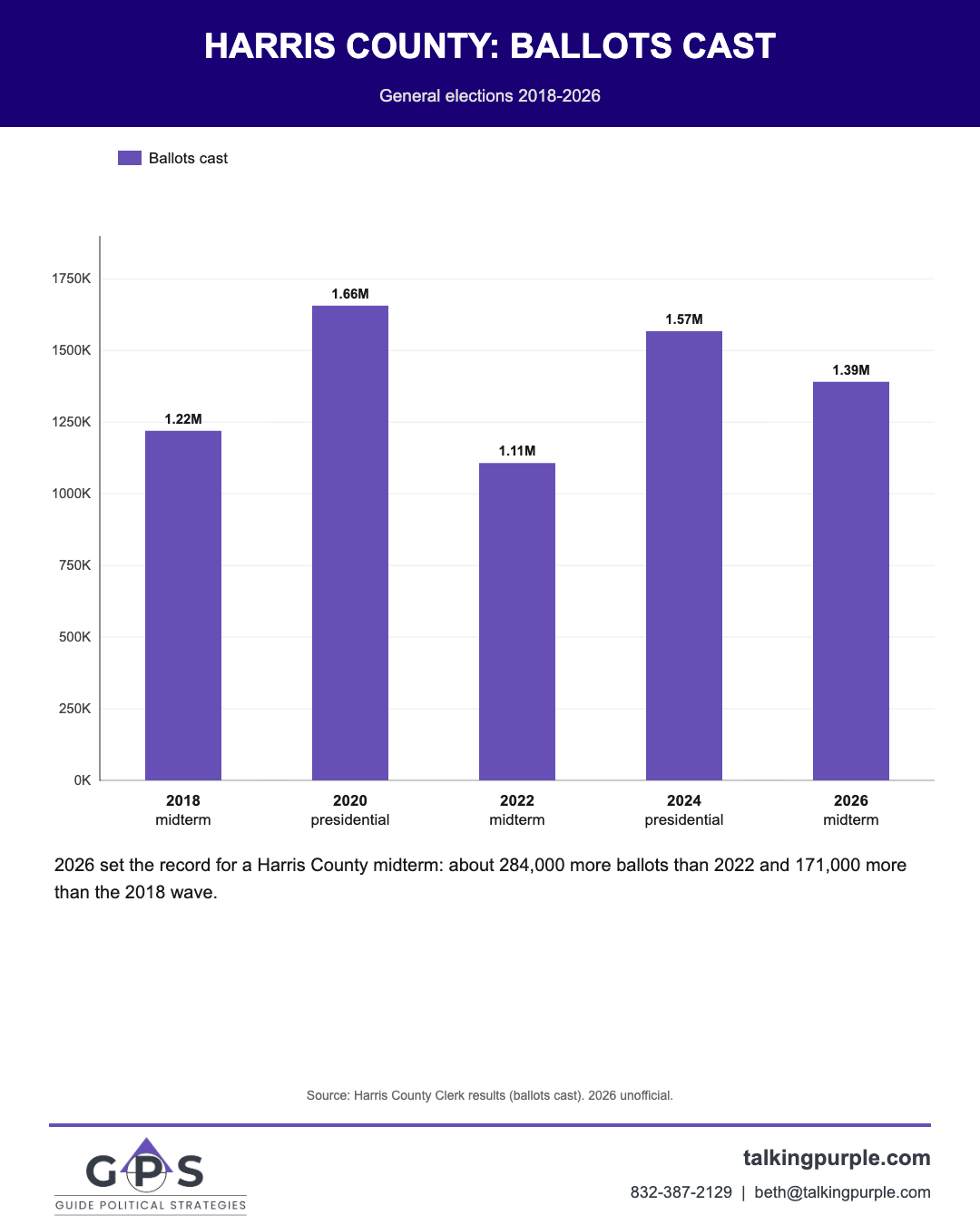
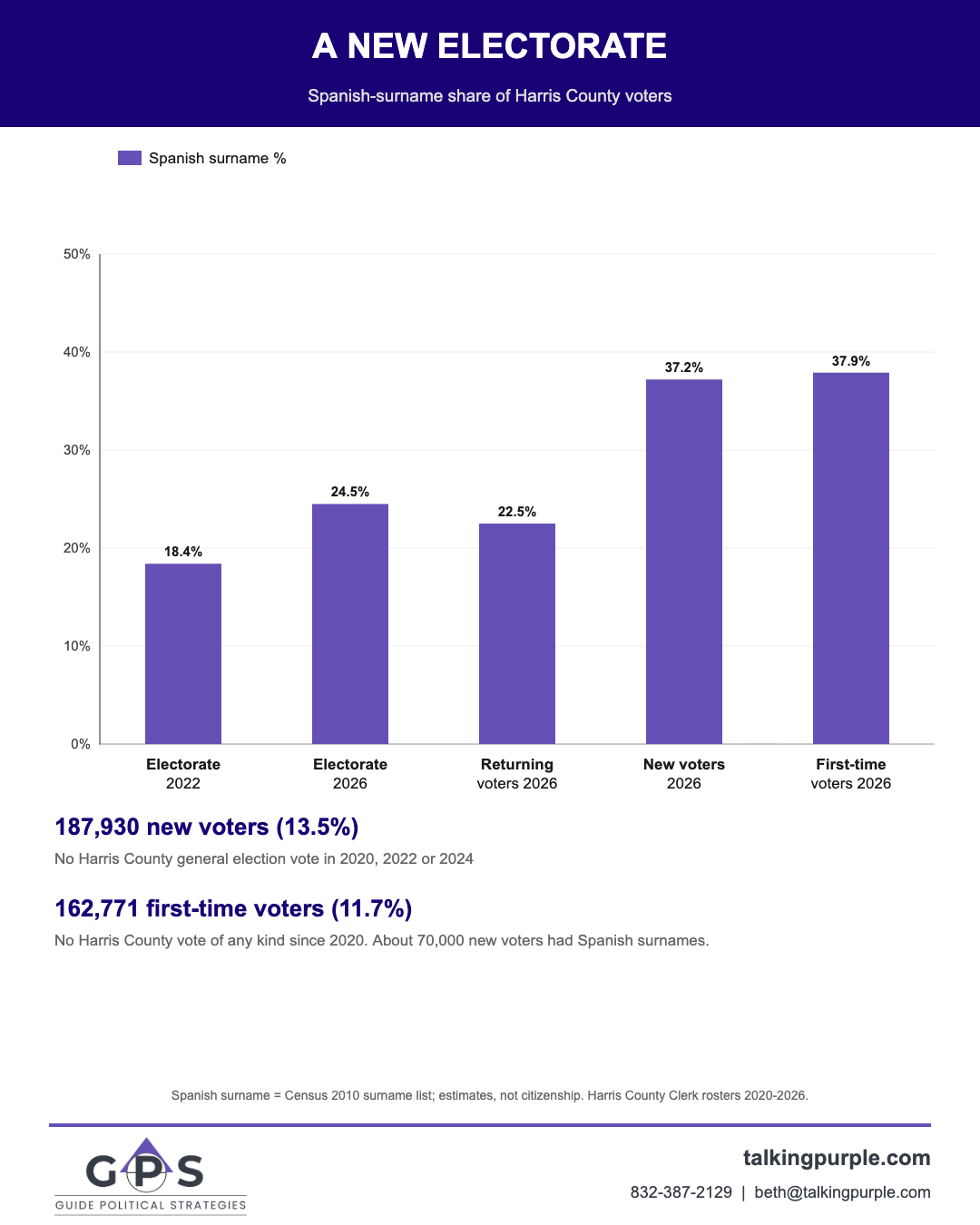
Nearly 188,000 people who voted in Harris County this year had not voted in any of the county’s last three general elections. About 163,000 had no Harris County voting record at all since 2020. Roughly one out of every nine voters was walking into a Harris County polling place for the first time in years, or ever. About 37 percent of those new voters had Spanish surnames, compared with about 22 percent of returning voters, roughly 70,000 new Hispanic voters. Two years ago, voters with Spanish surnames were about 18 percent of the Harris County electorate. This year, about 25 percent.
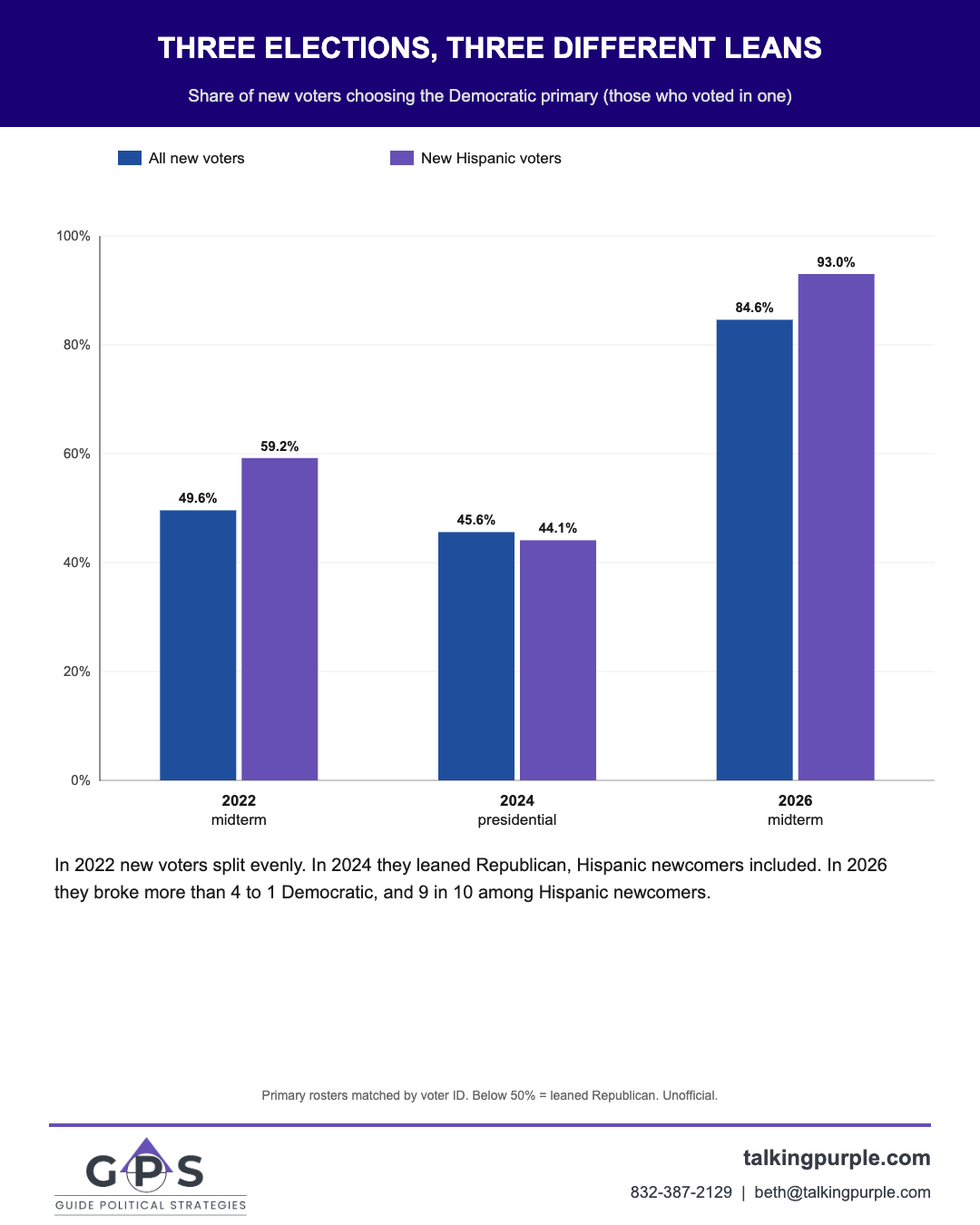
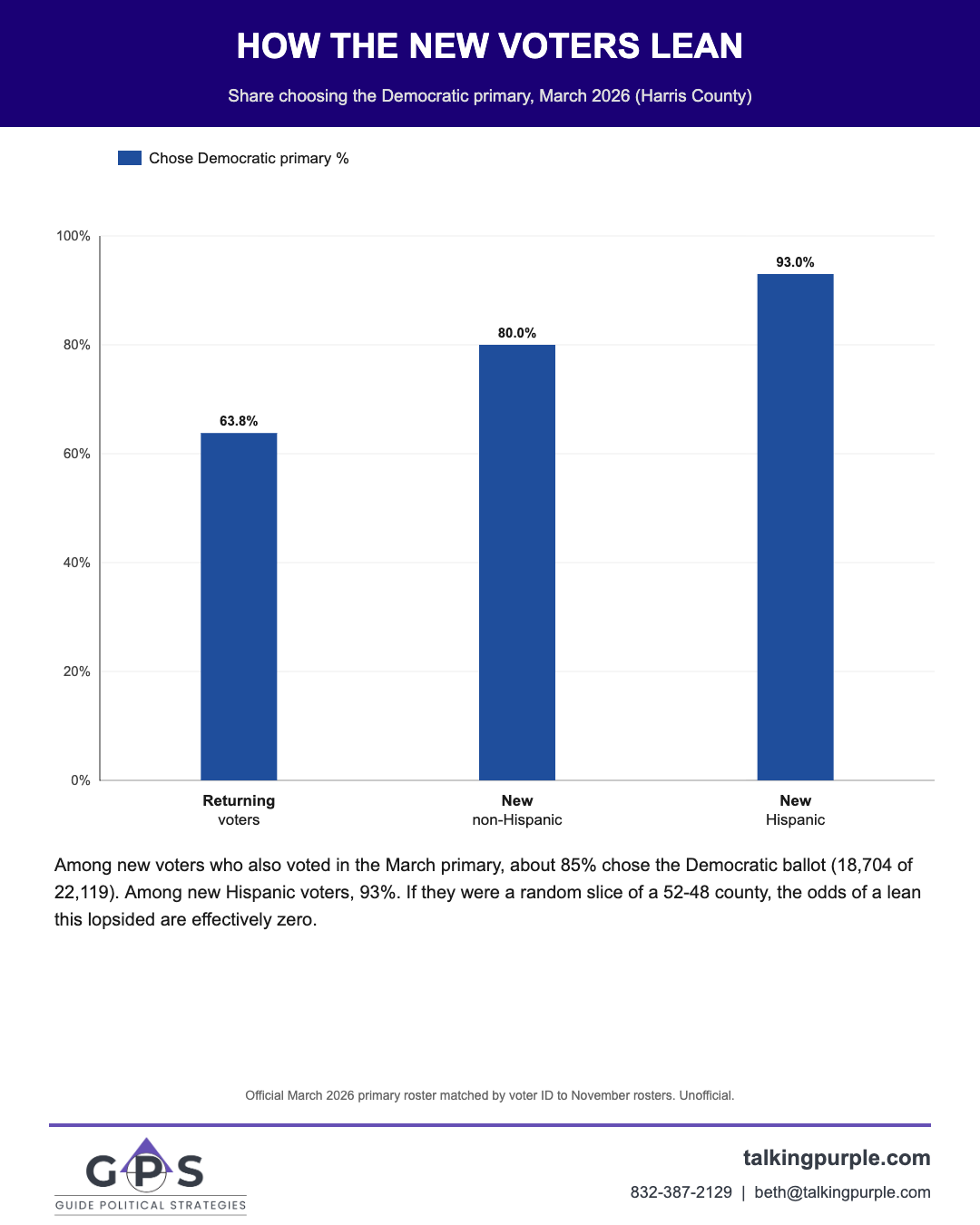
We can see which way they lean. Among new voters who also voted in the March primary, about 85 percent chose the Democratic ballot. Among new Hispanic voters, it was 93 percent. If those voters had been a random slice of a county that has been running roughly 52 to 48, the odds of a lean that lopsided would be effectively zero. Statistically, this is a distinctly different group of voters from the electorate Harris County has had.
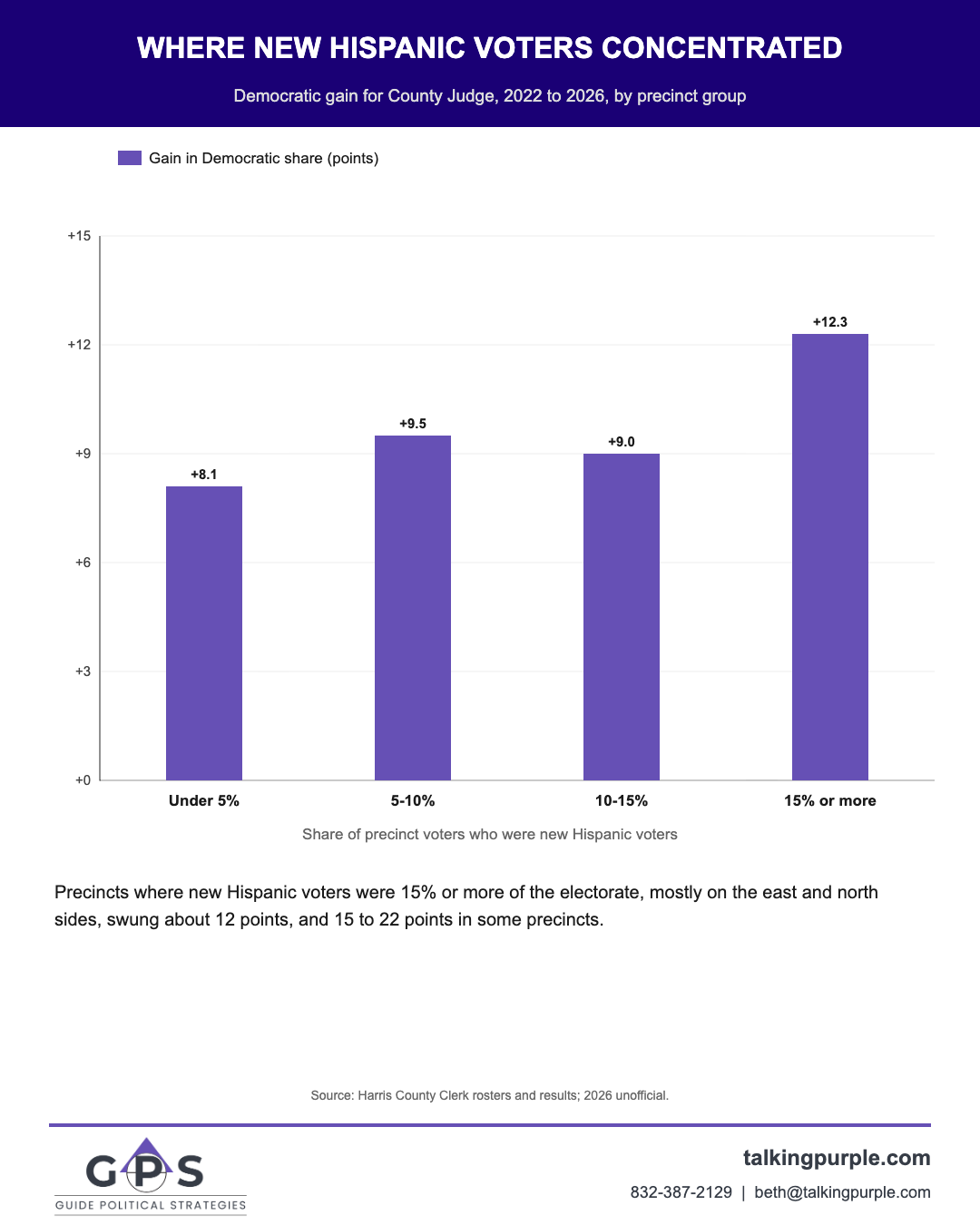
You can see it in the results. In neighborhoods where new Hispanic voters made up 15 percent or more of the electorate, mostly on the east and north sides, Democratic support for County Judge jumped about 12 points from 2022, and 15 to 22 points in some precincts. Where they were scarce, the shift was about 8 points.
Republicans Didn't Lose Their Voters
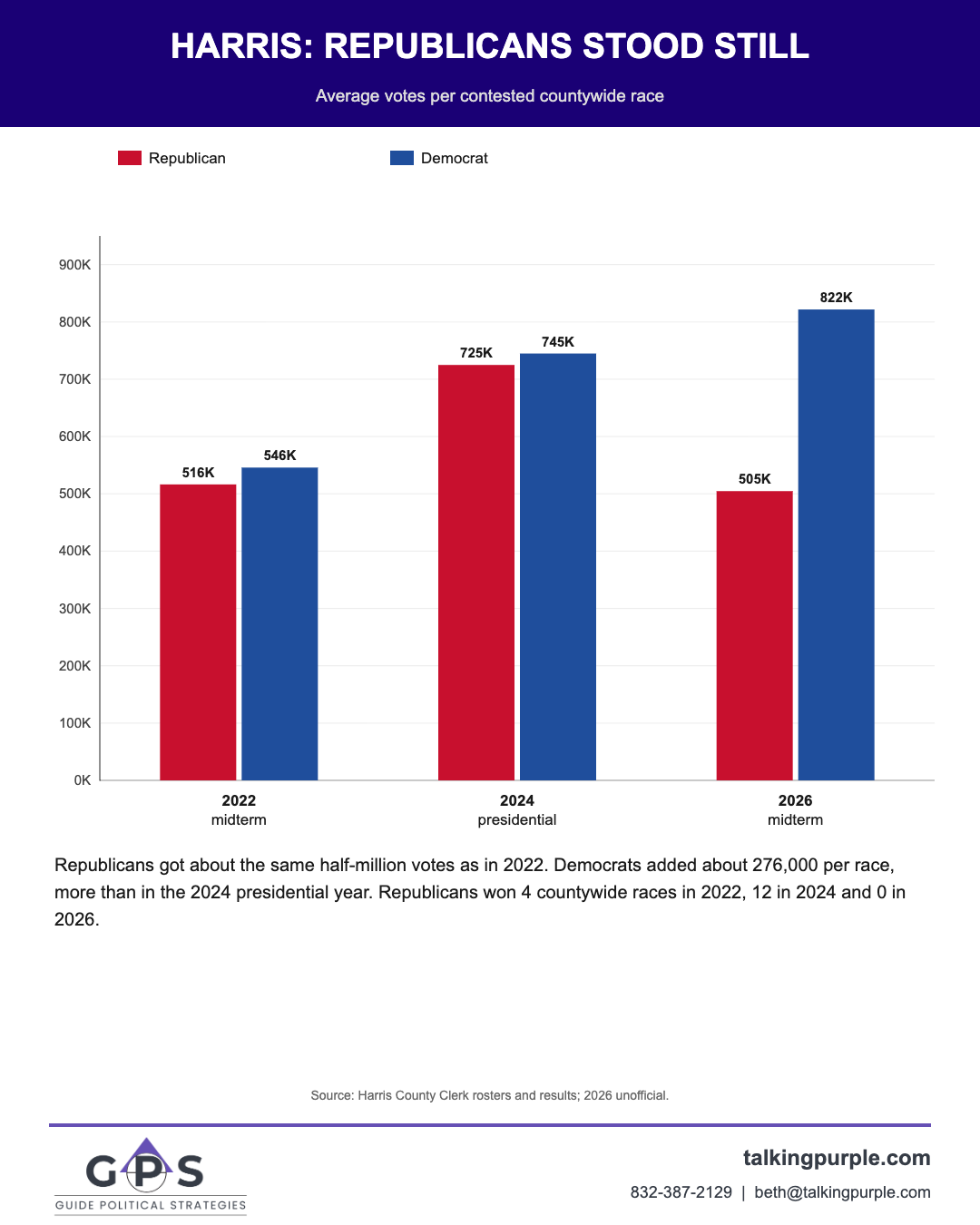
The average Republican candidate in countywide races got about 505,000 votes this year, compared with about 516,000 in 2022. The Republican base showed up for a midterm the way it always does. But about 284,000 more people voted than in 2022, and nearly all of that growth went to Democrats, whose average candidate went from about 546,000 votes to about 822,000. Republicans won zero countywide races.
Compare that with 2024. In a presidential year, Republicans averaged about 725,000 votes in Harris County, came within a point of breaking even and won 12 countywide races. This year, roughly 220,000 of those presidential-year Republicans stayed home, while Democrats drew about 822,000 votes in a midterm, more than the roughly 745,000 they drew in the 2024 presidential election.
What I Believe Is Happening
An election worker told me Democrats themselves were shocked by these results, Talarico aside. They never expected this. Here is my conclusion: I believe illegal immigrants voted in this election, and in meaningful numbers.
I know what some will say, so let me answer it now. First, this is not about ICE. As a naturalized citizen, I can tell you the legal immigrants I know are not upset about enforcement. We came here the right way, and we respect the law. If you do not like a law, change it. Do not just stop enforcing it.
Second, I am not alleging that anyone broke into a voting machine or stuffed a ballot box. If someone holds a voter ID number, the system has accepted them as eligible. That is exactly the problem. Texas does not require proof of citizenship to register. You check a box and sign your name under penalty of perjury, and that is it: an honor system. The state is supposed to check registrations against other records, but with registrations pouring in by the hundreds of thousands, I do not believe anyone can catch them all. If even a fraction of these new registrations belong to people who are not citizens, the effect is enormous in a county where margins moved by hundreds of thousands of votes.
That is why I call this an eligibility problem, not a fraud problem. The voters may be following the process exactly as written. The process simply does not confirm that they have the right to vote. And consider the millions of people who crossed the border and were moved around the country during the Biden administration. If even some of them obtained documents that let them register, could that tip close races in places like Kansas? I believe it could.
Who Can Investigate
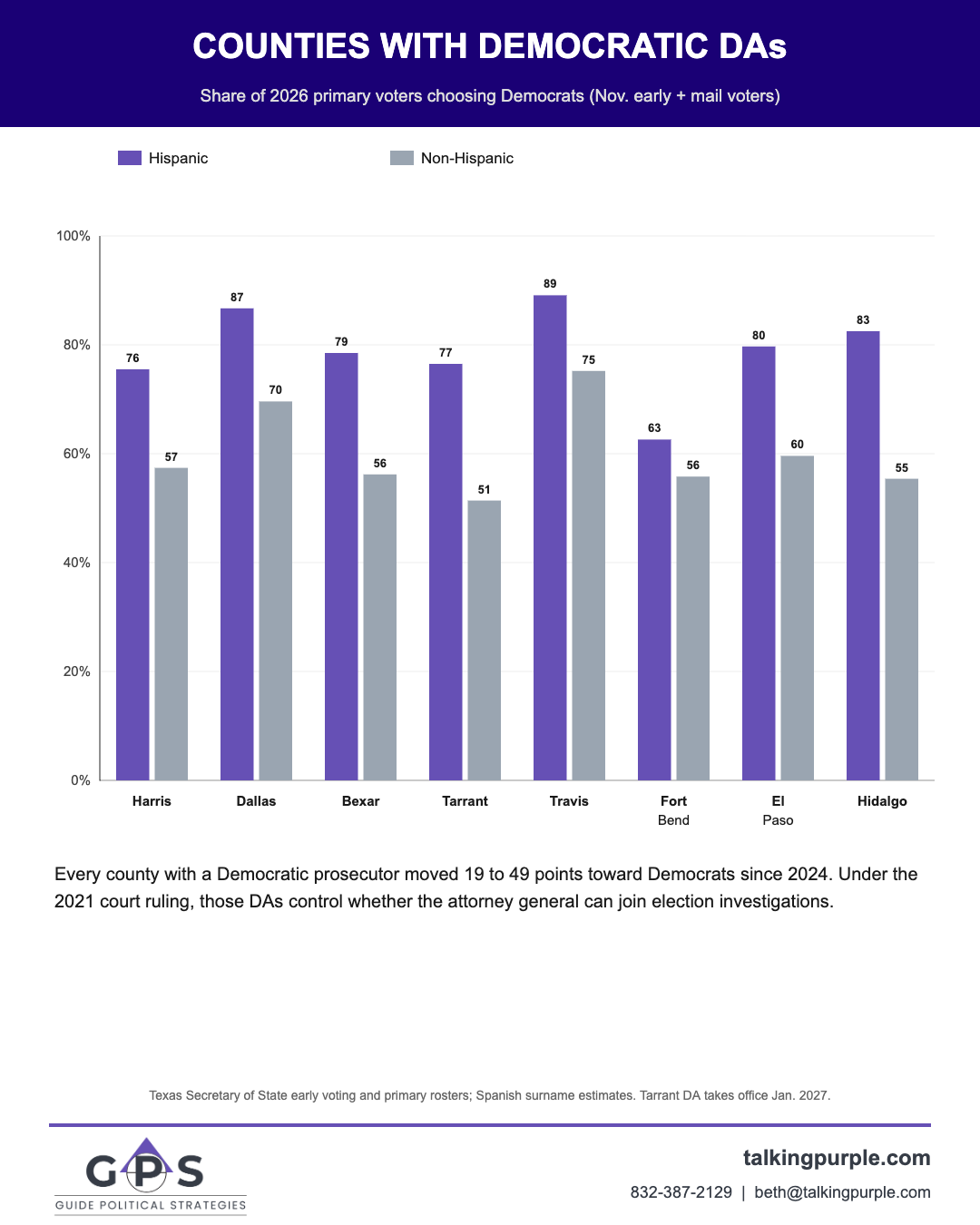
There is another obstacle. In 2021, the Texas Court of Criminal Appeals ruled that the attorney general cannot prosecute election crimes without an invitation from the local district attorney. Democrats now hold the DA’s office in most of the large counties where these gaps are widest, including Harris, Dallas, Bexar, Travis, Fort Bend and El Paso, and they won Tarrant this year. The Legislature passed a new law in 2025 to restore the attorney general’s authority, but it has not been tested in court, and no one knows whether it will hold.
A Pattern Worth Checking
One more thing, and it is anecdotal. Election judges in deep-red precincts and counties tell me they saw a wave of people who said they had just moved there and that someone told them to ask for a “limited ballot.” Texas law allows a voter who recently moved to vote a limited ballot on the races common to their old and new addresses. But election workers with 30 years of experience tell me they had rarely or never seen it requested, and several judges saw it repeatedly this year. Placing those voters in red areas makes them look a little less red and feeds the story that voters are simply fleeing Republicans.
Verify Before We Certify
To Senator Cruz, Attorney General Paxton and every Texas official with a role in the canvass: the time to verify eligibility is before these results are certified, not after. Once the canvass is complete and certificates are issued, the window closes, and questions about who was eligible become arguments no one can settle. Texas should check the citizenship and eligibility of every new voter who cast a ballot in 2026 against every record the state has, and do it now.
Going forward, Texas should require proof of citizenship to register for state and local elections, and every voter should have to recertify their eligibility. I believe illegal immigrants voted in this election, and I believe they will vote in larger numbers next time unless we close the loophole. If we do not act in the next few weeks, I fear the country as founded will not survive it.
Obama started the era we live in, and it will only get worse unless Republicans grow a spine and stop letting Democrats define them.
Data: Harris County Clerk voter rosters and precinct results, 2018 to 2026; Texas Secretary of State early voting and primary rosters. Hispanic figures are estimates based on Census surname data and do not indicate citizenship. Precinct swings reflect how neighborhoods voted, not individual voters. 2026 results are unofficial.
Talking Purple | 832-387-2129 | beth@talkingpurple.com
Related posts:
- Iran is a 47 year war, Texas Primaries and Elections
- Political Campaign Verification and 10DLC Registration: The Complete 2026 Compliance Guide
- Common Sense Over Chaos: Immigration, the Dignity Act, and Why We Need Real Solutions
- Game 5: Democrats Take Friday as Harris County Early Voting Turnout Rebounds